

A version of this post first appeared on the NAPO-WDC blog on October 28, 2026.
When people ask what I do, I often say "professional organizer," because it's the word everyone knows. But I call myself a life curator, and I wrote this piece for my fellow organizers in NAPO's Washington, D.C. chapter to explain why. If you're wondering whether to get help with your home, it's also the clearest description I have of how I work: listening first, helping you decide rather than deciding for you, and caring for the stories your things hold.
When I was considering a career change, after years of helping people sort their things, I wondered: Is this an actual job? Does it have a title? If I changed careers, what would I call myself?
My internet searches turned up "professional organizer," along with NAPO, professional certifications and training, and professional organizers with clearly amazing and impactful careers. It was exciting to discover that something I liked to do, was good at, and that really helped people was an actual profession.
But for me the title itself still felt a bit flat. When I hear organizers describe their work, I hear sleuth, coach, project manager, part-time therapist, and creative visionary, often with a lot of physical labor thrown in. "Organizer" covers maybe two of those. So I went looking for a term that captured more of the nuance and richness. I found it in life curator.
What "Organizer" Gets Right
Let's give the word its due. "Organizer" has real public recognition: in NAPO's March 2019 public survey of 1,005 people, 59% said they were familiar with the term "professional organizer" (NAPO, March 2019).
It also names our foundational skill. Cambridge Dictionary defines organizing, roughly, as arranging things according to a system that makes them easier to understand or use, and making the plans needed to get it done. That's the backbone of the work: seeing a pile of things, figuring out a logical arrangement, and executing the plan to make it happen.
What It Leaves Out
The word doesn't capture what it means to work with people so closely, often during vulnerable times or in a highly emotionally charged process. Sociologist Arlie Russell Hochschild named this emotional labor: managing feelings, your own and other people's, as part of the job. Organizers do a lot of it. Many of us say the work bleeds into a blend of therapist and coach.
"Organizer" also misses:
Listening. Building systems for this person means understanding their culture, their life circumstances, and how they actually live.
Discernment. Helping a client decide what is meaningful to them, and what belongs in their home with them now.
Research. Recognizing the importance of an item's lineage to a client, or tracking down the right donation home or resale option for an emotionally charged piece. Or even researching the right type of organization for this particular client.
Design. Arranging things so they are visually pleasing and practical.
Physical labor. The sheer physicality of the work.
Story. What stays in a home tells that person's or family's story: through clothes in a closet, food in a pantry, photographs and memorabilia, books and decorative objects.
To me, "organizer" also misses the emotional payoff. Clients often tell organizers they feel lighter. They've rediscovered parts of their past and identity they'd forgotten. They've stopped measuring themselves against an old or idealized version of themselves and started living in their current reality. The survey backs this up: among people who had hired an organizer, 38% reported less stress and about 17% reported improved relationships (NAPO, March 2019).
What a Curator Does
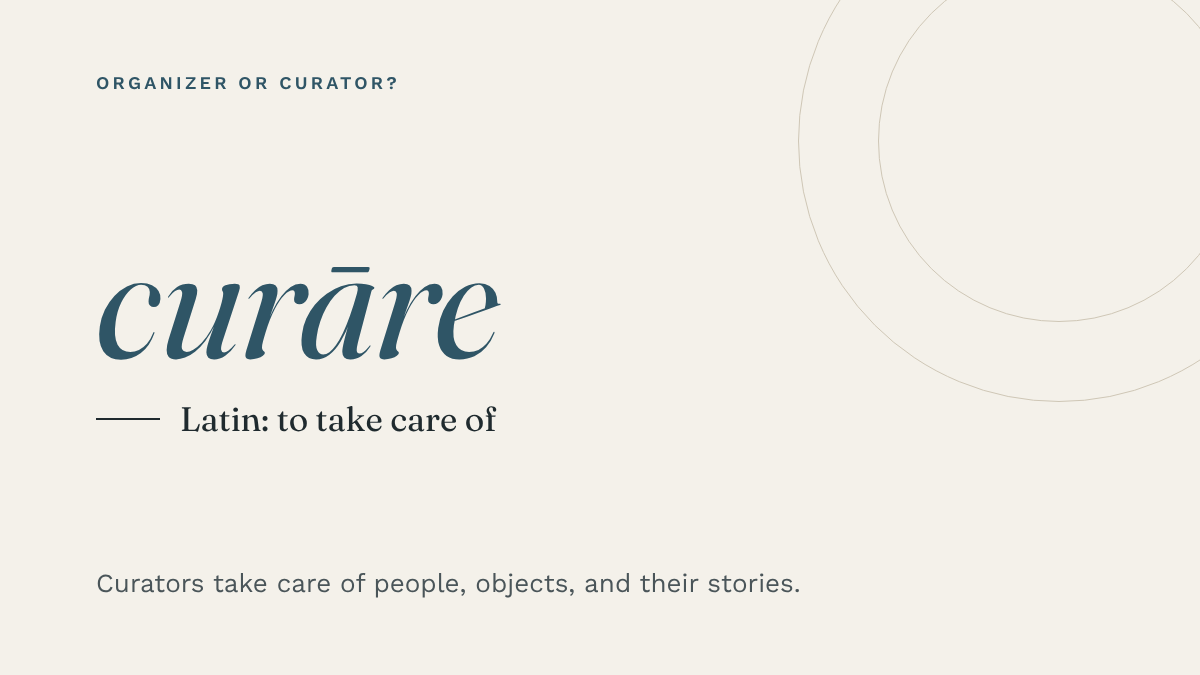
Curator comes from the Latin curare: to take care of. Curators take care of people, objects, and their stories.
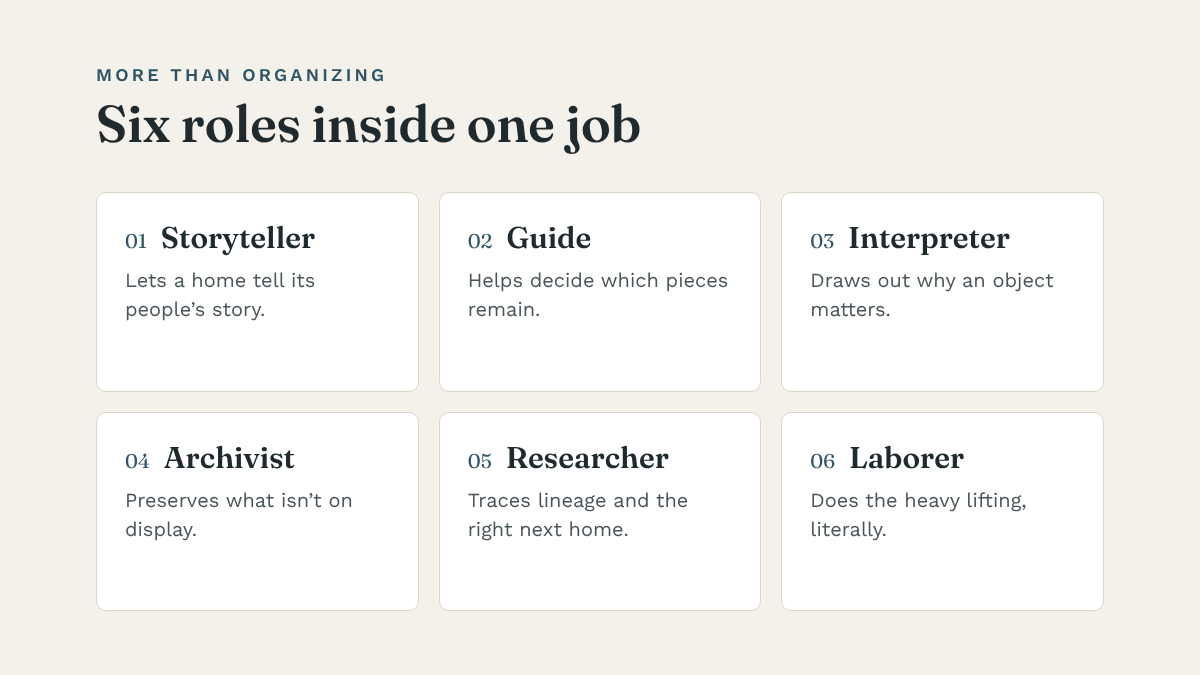
Above all, curators tell stories. They discern which objects tell the best story for a particular purpose, then display them so the audience can understand and enjoy them. Around that core, a curator is also:
A guide, deciding which pieces remain in a collection
An interpreter, helping people understand what they're seeing through creative arrangements
An archivist, preserving and storing items that matter but aren't on display right now
A mediator, helping living artists refine their vision and work
A researcher, educator, and leader, bringing logistical expertise, creative vision, organizational skill, and adaptability
A laborer, physically moving items and doing the heavy lifting of arranging displays and storage
That sounded like what I was doing. It's also how I hear many organizers talk about their work. Just see Jill Katz's May 2026 post, The External Brain, on the care involved in helping clients, or business partner Samara Goodman's Client-Centered Design, which echoes many elements of being a curator through her work as an interior decorator and designer. We are much more than people who sort objects into a logical order.
An example from my own practice: I helped a client empty and reorganize their storage room, which was packed to the ceiling. Organizing it involved a lot of physical labor: removing all the items, cleaning the room and the objects, and repacking kept items and returning them to the shelves. But it also involved asking probing questions about many items and gently challenging the client on why they wanted to keep them, to tease out each item's true emotional value. As I listened, we discovered that items hidden away in some of the most obscure parts of the room were actually incredibly meaningful. In the end, I suggested pulling those items out and putting them on display. The client marveled at the room's final result, saying I had given them their identity back. They started taking visitors into the storage room to show off their long-lost items.
Why the Word Matters
I think the word "organizer" makes the work sound like something anyone can do. NAPO's March 2019 survey suggests that's exactly how many people see it (NAPO, March 2019):
Clutter is nearly universal. 93% of respondents said they have at least some clutter at home, and 62% said some, most, or all areas of their home are filled with it.
Almost no one gets help. 92.6% had never hired anyone to help declutter or organize their home.
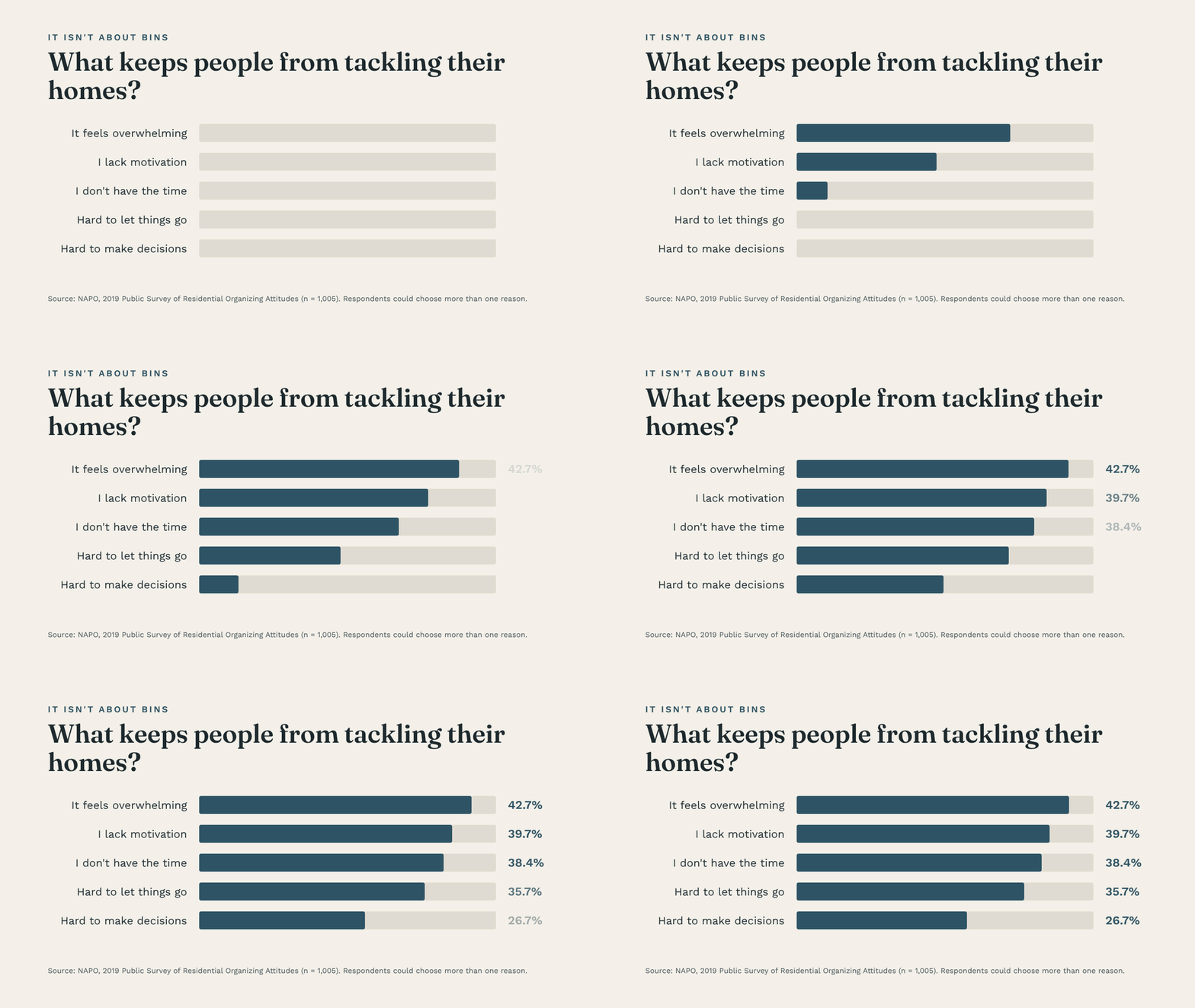
The barriers are emotional. The top reasons people don't tackle their clutter: it's overwhelming (42.7%), they lack motivation (39.7%), and they have difficulty discarding items (35.7%). Another 26.7% said they have trouble making decisions about it.
Yet people think they can do it themselves. Among reasons not to hire an organizer, 69% said "I can do it myself" and 41% said they already have a system that works for them, even with clutter in the house.
And they worry about us. 37% said they don't want someone handling their things, and 9% said they fear being judged.
Here's the number I find most telling. Among people who had hired an organizer, the top reason (45.2%) was difficulty deciding what to keep or get rid of. That isn't a storage problem. It's discernment, which is curation.
Social science points the same way. Research on why households don't hire domestic help finds that money is only part of the story. In a German study of couples who had never used domestic services, barriers included gendered expectations about who does housework, privacy concerns, and issues of trust and control (Trübner & Nisic, 2024). The same research team found that the quality, trustworthiness, and professionalism of services matter, not just affordability (DFG project report).
So the words we use matter. Corinne Berry made a related point on this blog in her post Being Organized Is a State, Not a Trait: how we talk about organizing shapes what people believe is possible. Most people think they can organize something, even if they don't actually do it. But do most people think they can curate?
Naming the complexity of the work boosts the credibility of our profession and people's willingness to outsource skilled labor. It also speaks to the fear that an organizer will come in, throw their things away, or shame them about their homes. Curators preserve. They don't purge.
The Fair Objection: Isn't Everything "Curated" Now?
Am I just trying to be fancy? Using a word that's popular right now? Playlists are curated. Coffee is curated. The internet has been abuzz for years about overuse of the word and the dilution of its meaning.
And the museum world has pushed back. Back in 2012, a UCL Museums blog post argued that if "organise" will do, you shouldn't say "curate" (Booth, 2012). Journalists and teachers have argued over what counts as real curation in their fields too (Schweigert, 2012; Gonzalez, 2018).
It's a fair challenge, and I take the test seriously: if all we did was sort, "organize" would do. But our work involves judgment about meaning and identity. We help decide what stays, interpret why it matters, preserve what isn't on display, and arrange what remains so it tells a story. That's curating by any definition. Despite the overuse, the word still evokes discernment, intentionality, care, and some measure of authority. Those are exactly the qualities and standards we maintain.
What Working with a Life Curator Looks Like
You don’t have to call it curation to benefit from it. Whoever you hire, here’s what to look for, and what you can expect from me.
Care and expertise. A good organizer takes time to understand you before creating a system that fits your life. Look for membership in NAPO (the National Association of Productivity & Organizing Professionals). Members are bound by its Code of Ethics, which covers your privacy and your belongings.
Discernment, not just sorting. If you’re looking for more than pretty boxes and bins, the work should sound like discerning, selecting, inventorying, interpreting, preserving, and displaying - all tailored to you. You’re telling the story of your home and crafting a home that is just for you, not just filling identical bins.
Help with the hard part. If you’ve thought “I can do this myself,” you’re not alone. In NAPO’s survey, 69% of people said the same, while 62% said some, most, or all areas of their home were filled with clutter. The hard part is rarely the shelving. It’s deciding what matters and finding a system that works for you. That’s why when people did work with a professional organizer they found the organizing and sorting easier.
Room for your worries. More than a third of people don’t want someone handling their things, Inviting someone into your home feels very private. Voice your concerns up front. Ask in your initial conversation about their process. Nothing should leave your home without your say, and you can clearly outline which parts of your home you are comfortable sorting. This is another reason why finding an organizer who is a member of a professional association like NAPO is a good idea. You can be confident in their discretion and ability to sensitively work with you.
Your story, kept. You should feel heard. In sessions, proposals, and session summaries, I reflect back the story I’ve heard: the objects that matter, your worries, and your hopes for them. When an object’s history comes up, I can help you write it down or record it for you. I can also help you use other resources and connect with other experts who will help you keep those stories with your family for years to come.
So, Organizer or Curator?
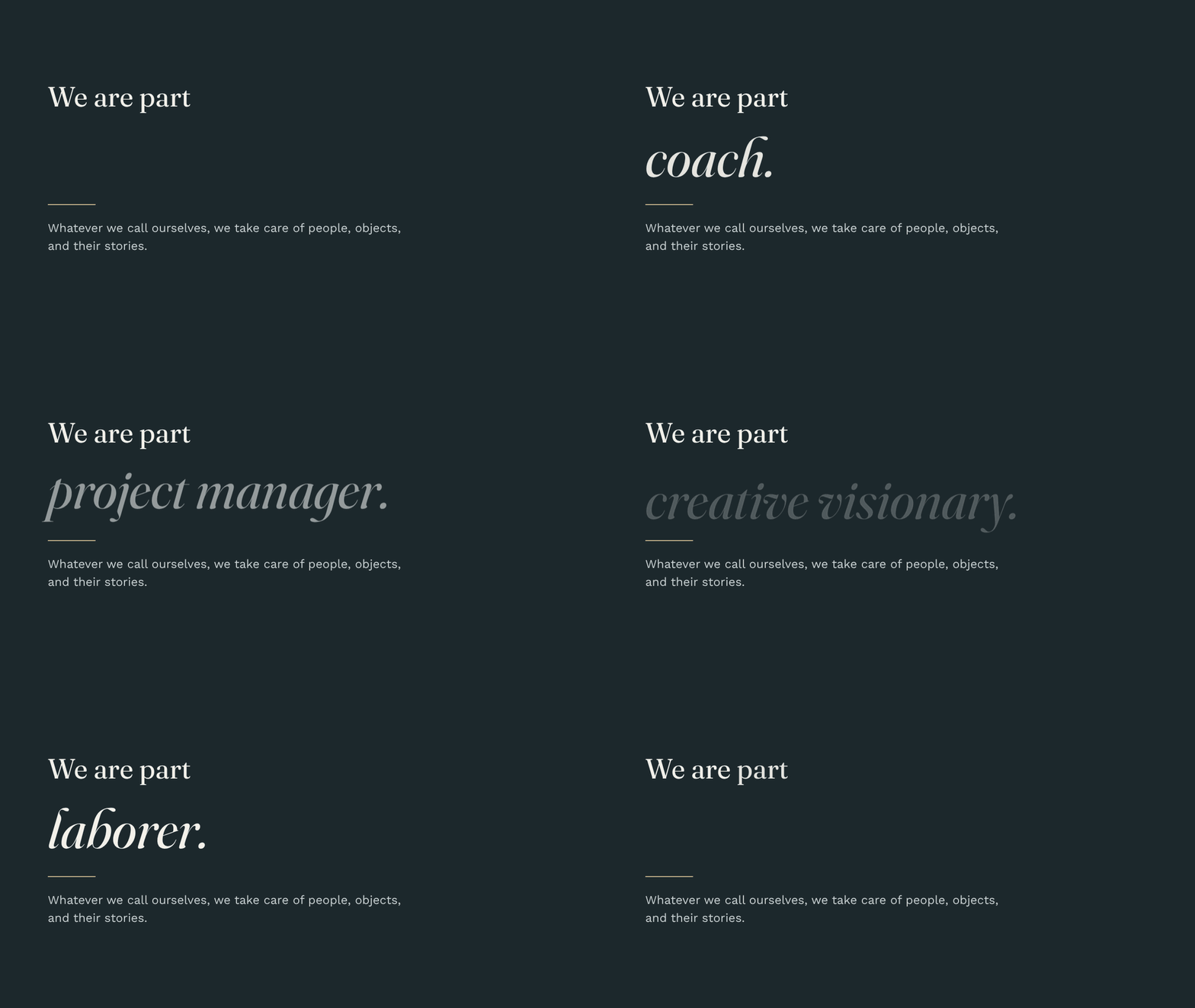
Organizers are part sleuth, part coach, part project manager, part therapist, and part creative visionary. Whatever we call ourselves, we take care of people, objects, and their stories.
If this sounds like the kind of help you've been looking for, there are two ways to begin. Download the free guide, Reading the Layers, to start seeing the layers in your own home. Or request a complimentary Threshold Conversation, and we'll talk about where you'd like to start.
